Comparisons
Sermorelin vs CJC-1295
The useful comparison starts with duration. It also needs two clocks: the peptide’s time in blood and the gland’s response.
Sermorelin half-life
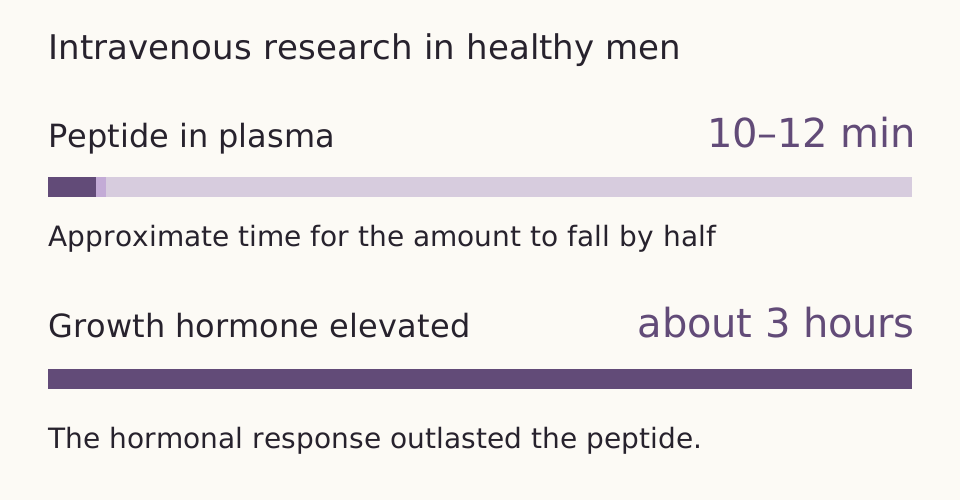
After intravenous administration, Sermorelin’s plasma half-life was on the order of 10–12 minutes. Half-life means the time for the amount in blood to fall by half. Yet growth hormone remained elevated for about 3 hours in the pharmacokinetic study. The study enrolled 30 healthy men and also investigated the intranasal route.
I prefer that mismatch to the familiar claim that a short-lived drug must have a short-lived effect. The pituitary’s response continued after much of the peptide had cleared. Duration has to specify what was measured.
Albumin binding and longer-acting analogs
Sermorelin and CJC-1295 stimulate the GHRH receptor. The long-acting CJC-1295 form with DAC can bind albumin, a blood protein, extending its stay in circulation. That is a different chemical strategy from attaching polyethylene glycol, or PEG, to a GHRH analog. The review of PEGylation describes that second approach, while the GHRH pharmacology review supplies the broader family context.
A comparison needs to specify the CJC-1295 form. The albumin-binding account concerns the DAC version. I’m suspicious of comparisons that quietly drop that qualifier and then rank everything by how long it remains in the blood.
Longer exposure gives a study a different endocrine pattern to investigate. Selecting a winner would also require outcomes and safety data for the population being discussed.
What prolonged stimulation left unresolved
One study of PEG-conjugated GHRH recorded mild, transient injection-site reactions and some impairment of glucose tolerance in elderly subjects with repeated dosing. The compound was a long-acting PEG-conjugated analog. Its findings concern that preparation and study group; they cannot supply a CJC-1295 adverse-event rate.
Continuous infusion adds another complication. In children receiving continuous GHRH(1-29) infusion, an early increase in GH was followed by a decline by 3 to 6 months, with complete suppression in one child. The investigators considered several possible explanations, including antibodies and receptor desensitization. This continuous-infusion result raises a question about pattern as well as duration.
Sermorelin and HGH
Sermorelin stimulates the pituitary; direct HGH supplies the hormone from outside. Walker’s editorial argued for the physiological appeal of stimulating secretion while preserving feedback. There’s an elegance to that physiology that I appreciate. It still needs a comparison trial.
The study amounts page preserves each route and population. For the outcome questions—growth, IGF-1, body fat and memory—the research record is a more useful next stop than another half-life ranking.